Saturday, 24 December 2016

The first statue of the Buddha.


The visual and textual narrative that I present below are considered to be small fragments of the larger Buddhist culture and legends
Lord Buddha was staying in the Jetavana monastery of Savatti (Sravasti), capital of Kosala, ruled by King Pasenadi. One day, King Pasenadi went to pay homage to Lord Buddha. But when the Lord Buddha announced he would leave for three months in Tavatimsa Heaven, the king and his followers felt sad, and made known to the Buddha their feelings, should he die.
The next day the King visited the Buddha to ask permission to make an image of him. On being granted permission, the King had a statue carved using sandalwood of the Lord Buddha in the sitting position. It looked exactly like Buddha and it was housed in the place where the Lord used to sit. Upon Lord Buddha’s return from Tavatimsa heaven, King Pasenadi invited him to look at the sandalwood image. On seeing the Lord Buddha, the image acted as if it were alive and knew it had to rise to show respect to the Buddha. Possibly there was an instant of eye contact, it started to move from the seat and was about to pay homage when the Buddha raised his left hand to stop the figure, saying “You will remain seated”.
After that, the Lord Buddha preached a sermon about the merit gained by making Buddha images. It is believed that the sandalwood image was the very first image in Buddhism.


The Legend in Thailand


In modern Thai iconography the statue of the Buddha refraining his image to rise, was codified (“Halting the Sandalwood image “) with the right arm pendant alongside the body and the left hand raised to prevent the sandalwood from rising (Matics 1988; 103). It is believed that not only is this sandalwood image the oldest ever created but also that it was the first image when the Lord was still alive. Copies of it are highly venerated in Northern Thailand and are always depicted his right hand pressing on the seat (so as to rise).
According to old Thai narrative, the Tamnan Phra Kaen Chan, the first image of the Buddha was made about seven years before Lord Buddha passed away (Shober 2006: 34). The myth of the first Buddha image gave origin to several legends. One rare stone sculpture of Gandhara art is interpreted as King Udajana presenting a Buddha image to the Buddha himself (Skilling 2006: Fig1). The original sandalwood image mentioned above disappeared after the 16th century while canvas paintings of the Buddha are various and in known locations (Skilling 2006: 228). On the wall of the ubooth of the Emerald Buddha in Bangkok, there are 72 paintings illustrating Buddha in different attitudes, preserved in elaborate guilt frames, renovated in 1831 during the reign of King Rama III. One painting is entitled “Urging Phra Kaenchan (the sandalwood statue in his semblances) not to rise from his seat” (Ambai 2004: 295).


The Legend in Burma

The legend of the first statue of Lord Buddha is also well known in Burma (Myanmar) where the renowned image of Mahāmuni is believed to be the living double of the Buddha. Here the legend is adapted in that it was made by King Candrasuriya, an Arakanese king who lived at the time of the Buddha (Shober 1997: 265). When the Buddha prepared for his departure, the king lamented that he and other devotees could no longer be able to pay homage to Lord Buddha so asked for an image in his likeness. Reflecting on the greatness of the kingdom and the king’s need to gain inspiration, the Buddha consented to the request. Sakka and Vissakamma cast his image and created an exact replica of the Buddha’s physical appearance (Indra and Visvakarman, the architect of the gods). In the Burmese legend, Buddha breathed upon the image to impart life to it and the image was transformed into a life-like one. King Candrasuriya made offerings and placed the image on a throne under a turret, then built monasteries around it and entrusted monks to take care of the image.
The Burmese legend follows the original legend. When the Buddha was brought to see the sandalwood image, the latter made the movement of rising to pay respect to the Lord. The Buddha raised his left hand in Abaya mudra and stopped it by saying ‘Oh young brother do not stand up. I shall enter Nirvana in my eightieth year, but you, endowed with the supernatural powers of a Buddha, shall exist for 5,000 years, which I have prescribed to be the limit of my religion; you shall be the means of working out the salvation of men and nats’ (Shober 1997: 268).


Some thoughts on the Legend.


The Buddha, in recognizing his likeness in the sandalwood image (and vice-versa), set in motion the process of iconization: the investment of images with authority and direct links with the Buddha (Skilling 2006:231).
The sandalwood image traveled in the imagination of Buddhists not only in its material form as the object of veneration, but its enshrinement sites also became the destinations of pilgrimages. Buddha statues traveled to each corner of Buddhist Asia acquiring the idealized form of a man local to the region but with superior spirituality, radiating inner and outer beauty. Rituals were performed around statues giving gradual rise to the cult of an image, so idolatry was born: a cult hardly acceptable to the Buddha, as was the commercial idea of merit-making by paying respect to the Buddha’s statue followed by the concept of acquiring merit in making new Buddha images or renovating older ones. The statue being perceived as the living image of the Lord invited consecration ceremonies where the eyes of statues were opened; or consecrations of amulets with small images of the Buddha or of holy monks, especially in Thailand. Thus Buddha’s statues became the center or religious buildings.

Kings of the Chakri dynasty moved statues from dilapidated temples in the North of Thailand to their capital, Bangkok. Many Laotian Buddha statues were taken as war trophies and religiously installed in Thai temples. Gradually the statue was given potency, miraculous powers, and the ability to make people overcome difficult situations or fulfill a wish.
Gilding of Buddha bronze statues was allegorical of the brilliance and splendor of the Enlightened, besides reflecting the wealth of the donor. The statue was an image of the Buddha and sacred as such. Despite being considered as living images, in mainland SE Asia and especially Thailand, Buddha’s statues were made of glass (and more recently in multicolored plastic resin).
Some important simulacrum, such as the Emerald Buddha of Bangkok, is subject to changes in its adornment according to the seasons; other statues are simply covered with monk’s robes and regularly washed as if they were living. Finally, the image of the Buddha could not escape modern entertainment with a colossal seated cement statue being the main attraction of the ‘Buddhist Theme Park’ of Wat Muang (north of Bangkok) reaching the height of 92meters, named Phra Buddha Maha Navamin.
The name given to a specific statue often depends on the financial donor or maker, or, as in Thailand, also according to their weight or height, fabrication techniques and materials (Aroonrut 2006:45). In Thailand emphasis was paid to the mudra, position or articulation of the statue (Matics 1998).

In the legend of the Buddha and his identical image, it is possible to perceive several meanings such as the relationship Buddha/king, Buddha/homeomorphic image, Buddha/artist, father/son, subject/object, observer/observed. In Cambodian legend the carved image of the Buddha was perceived as that of the Khmer king to be venerated jointly to that of the Buddha with the plinth of the statue equated to the throne of the Khmer king. Incidentally in modern Cambodian iconography, the mudra of the Buddha differs, insofar he use his right hand to dissuade the statue from rising.


Bangkok, October 2014


[1] Or the Pali Jinakālamālini (2006:227)


Fig.1- Mural painting showing a sculptor presumably carving the first statue of the Buddha out of sandalwood. Battambong temple


Fig. 2 – Wat Pho (Bangkok). Lord Buddha urging Phra Kaenchan (the sandalwood statue in his semblances) not to rise from its seat (painted c. 1831 CE, Third Reign)


Fig.3 – Angkor Wat North monastery (Siem Reap, Cambodia). The Buddha encountering his statue and asking it not to rise to pay homage (end 20th century)

Fig.4 – Wat Prasat Andet (Kampong Thom, Cambodia)– Lord Buddha stopping the sandalwood to rise (end 20th century).


Fig.5 - Another example of the Buddha telling the statue not to come alive by raising his left hand in the abhaya mudra. Wat Damrei Soer, Battambnong, Cambodia.


Tuesday, 6 December 2016

Angkor Wat Western Corner Pavilions of the Third Enclosure


Angkor Wat Western Corner Pavilions of the Third Enclosure
By Vittorio Roveda (@ copyright text and pictures)
In this paper I want to call the attention of scholars and non-scholars to the extreme refinement and beauty of the reliefs carved in the West  Corner pavilions of Angkor Wat, usually visited quickly after been mesmerized by  one of the long reliefs of the gallery bringing to the  pavilion. This is the first approach by a western art historian to read in images [of the reliefs] elements that refers to personal views ant not only to historical and rhetorical interpretations.

I start by presenting here, the drawings on the Southwest corner pavilions showing the distribution of carved reliefs. Then I have selected my preferred relief and explained it in great detail. I highlighted its most elegant and delicate carving - in my opinion - unique and unsurpassed in all Angkor Wat, made during the rule of Jayamarman II (1113-1150).
Needless to say that I published all details, comments and conclusions in my book SACRED ANGKOR of 2002, published by River Books, Bangkok,
I believe that if the god Indra and the divine architect of Angkor Vishvaakarman would challenge me to choose the best carved relief of Angkor Wat’s corner pavilions I would without any hesitation indicate the scene of the Water Festival because it shows two majestic boats floating slowly on the river of dreams, exciting the concept of happiness, distance from daily life problems, peace and equality. The dreams float on the river of an archaic time, giving me a subconscious pleasure and awareness of my life’s flowing. Going beyond my oneiric phantasies, I need to come back here and talk of ‘my’ reliefs.

Introduction
Very little has been written since the 1960s on the reliefs on Angkor Wat’s corner pavilions. C. Bhandari (1995) view them with the background of Indian scholarship, and E.Mannikka included the reliefs of the corner pavilion in her study on the architectural-cosmological study of Angkor Wat. Both Coedès (1911) and A. Le Bonheur (1989) were concerned about a thematic logic and concluded that each individual pavilion has its own panel’s arrangement which is independent from that of the Large Panels of the galleries. These illustrious authors were concerned of the apparent lack of ‘logic’ in the arrangement of the various panels, a concerned shared by myself (2002), and discussed here below.
I was the first to describe the western corner pavilions in detail in my 2002 book SACRED ANGKOR (available from River Books, Bangkok).

Technical features of the reliefs

Each pavilion – having a cruciform plan – has 8 large carved panels on the 4 walls, and 4 on pseudo-lintel over the doors) Same of the large panels occupying the full wall (circa 4.5 m high and 3.5 m wide), others only part of it (circa 3 m high and 3.5 m wide) and the pillar at the side of the window (circa. 2 m high and 2-2.30 m wide; see figs. 2, 3, and 4).
The lintel, which in a door in all Khmer temples has the function of spreading the weight of the overlying structure on the doorjambs, does not exist in the corner pavilions, but is carved well over the normal position of a linter, carved on the wall of the pavilion. Having the elongate shape of a lintel I have named them pseudo-lintel, each standing high over the four doors of the corner pavilions of the average size (c. 2 - 2.5 m high and 3 m wide), composed of a flat tympanum framed by an arch made by an undulating naga, as in all Khmer lintels and pediments.
Khmer sculptors made use of the most common pictorial device, the ground line, or base line, on which the figures appear to stand. This was probably in order to supplement a weak concept of picture space and the lack of a systematic perspective system. The use of ground lines allows to a stack horizontal arrangement of the elements of the relief.

Sequential and logical order?
I have mentioned above there is a problem in searching a “logical” arrangement of the reliefs in each corner pavilion and with other reliefs of Angkor Wat. No such thing I can see, but perhaps there was an order of cosmological type or a scheme that followed the pattern of a mandala that elude us at present.
Khmer Brahmins may have follow an old Vedic tradition by which the content of the narrative chanted (narrative from a text) was superseded by the sheer ritual act of chanting or whispering or mentally reciting the texts. Relevance was on the ritual of reciting these stories, not on the arrangement of such stories on walls. Therefore, the arrangement’s order of mythological themes in each corner pavilion may have been induced by the most important Hindu/Vaishnava ceremonies, or ancestors ingratiating ceremonies, or agricultural propitionary rites, to be held/chanted each year in specific order and in a specific corner pavilion.
Even the arrangement of the famous long carved panels of the galleries of the third enclosure are subject to controversy and some scholars suggested to start the visiting Angkor Wat from galleries from the eastern side and specifically from the relief of the Churning of the Ocean of Milk, charged of symbolic meanings, erroneously taken as the Creation myth (Maxwell, 2002: 16).

The Dvaravati Water festival (Roveda 2002: 122)
I presenting here only some features of my preferred reliefs of the southern Gallery. The relief of the so-called Dvaravati Water Festival because It depicts a Krishn’s event when he attending a water pilgrimage - as written in the Harivamsa - from the city of Dvaravati to Pindaranca. The relief is carved very shallow and is highly polished, difficult to see in most light conditions. The best photographs attached here were taken in 1995 by Jaro Poncar at night with light close to the wall. The pictures in colour were taken by me in daytime (1996-2001) when scaffolding was made available to me by Mr Long Nari, head of the GAPCO restoration team.
The relief displays two pleasure boats flowing quietly on a large river, frozen in time. The boats are the typical royal barges with the bow ornate of a very high dragon head (usually made of bronze) and the back of the elevation simulating the tail of the dragon. The front boat is that of the male companions with, at the centre, two dominant figures, Krishna and Balarama or two princes or important courtiers (?) playing Khmer chequers inside a delicately carved wood pavilion of Khmer style. They are surrounded by girls having apsara hairstyle, holding fans. They may be of women of the harem or female bodyguards of the king.
At the front of the boat (bow) seated girls are watching some crew-members hunting monkeys with their blowpipes. The boat is overcrowded; a row of rowers, works hard in unison. The water is full of fish and crocodiles. Nobody is restless or worried. However, at the back of the boat (aft) the man at the helm (drunk?) seems to have his head unusually supported by a crew-number. Local farmers or crew-members are shown climbing coconut trees.
This scene of the males boat overlays that of a boat with female figures in a pavilion with curtains, mothers (queens?) breast-feeding their children, others attend the more grown up; some young girls are embracing. Around their regal wooden pavilion are only men, in contrast to that of the princes surrounded by girl in the boat carved above. Noticeable is the male figure with crossed legs sitting in front of the queen, raising a child full of affection
Crew-members hold large parasols. The crew seems to be in disarray with men pointing to the end of the boat (aft) where a fierce cock-fight is watched by sailors and gamblers. This scene in probably the centre of attraction of all the rowers, unconcerned of where they are going. The man at the helm is also looking upwards while a sailor is behind him is fishing.

Personal view
I like the first boat with personages playing chess totally unconcerned of what is going on. It is for me, symbolic of being able to detach from the noise on society the ruler playing his game and his life in perilous waters. However, my preference is for the second boast, the one with women, symbolic of opulence, matriarchal rule, femininity and life. Also this boat is overloaded, with the waterline almost at the limit, in danger of sinking and capsize, tragically ending the pleasure trip, becoming a memory and a myth, like many life events.  I see a symbolism for the fleeting moments in life, the meaningless of attachments and desires.
Altogether I like the contrast, yin and yen, male-female, power and charm between the two boats.
Both flow silently on the waters of the myth in an undefinable time.

 From the technical point of view, one can appreciate the refinement of the carving and the life infused in them. The genteelness of the carving and the mastery of the visual narrative, are outstanding and unique in all Angkor Wat. I believe that the two western comer pavilions were carved by a workshop not involved in the large panels of the same third enclosure


correlaTion of stories carved on wall with the text NARRATING them.

SOUTH-WESTERN CORNER PAVILION

SW.1 – The churning of the Ocean of Milk                                 Bhagavata Purana. 8 (7)
SW.2 – Krishna lifting Mt. Govardhana                                      Bhagavata Purana 10 (24)
SW.3 – Rama killing Marica                                                      Ramayana VIII
SW.4 – Shiva in the Pine Forest                                                 Linga Purana 2 (9)
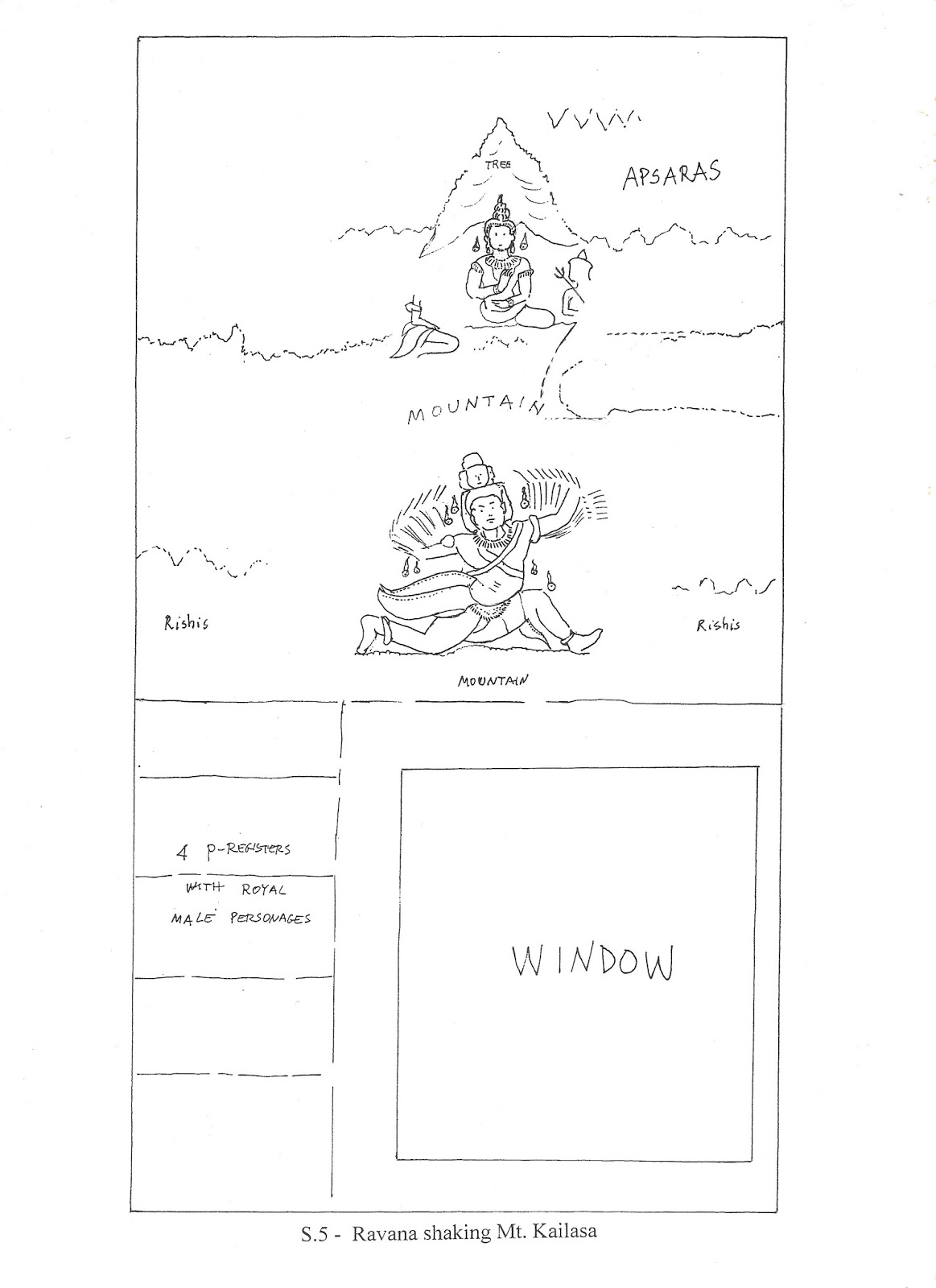
SW.5 – Ravana shaking Mt. Kailasa                                           Ramayana. VII
SW.6 – Krishna as a young boy dragging a heavy mortar           Bhaghavata Purana 10 (9)
SW.7 – Shiva reducing Kama to ashes                                       Shiva Purana 16
S.W8 – The death of Valin                                                         Ramayana IV
SW.9 – The Murder of ?Pralamba & The dousing of a fire         Bhagavata Purana 
S.W10 – Dvaravati water festival                                               Harivamsa 12
S.W11 – The betrothal of Shiva and Parvati                               Vamana Purana 25 (26)
S.W12 – Krishna receiving the offerings destined for Indra         Bhagavata Purana 10 (24)

 Note. Italics refer to pseudo-lintels

In hope to be able to continue the reading of some other relies specifically chosen for my personal interpretation.

I hope to repeat soon a similar appreciation for a relief carved in the North-western Corner Pavilion.


ESSENTIAL BIBLIOGRAPHY
Bhandari C.M., Saving Angkor, White Orchid Books, Bangkok, 1995.
Bonheur Le A., Cambodge. Angkor. Temples en peril, Paris, Herscher, 1989
Coedès G., Les bas-reliefs d’Angkor-Vat, Bulletin de la Commission Archéologique de l’Indochine, Paris, 1911, p. 170-220
Glaize M., Le guide d’Angkor, Flammarion, Paris, reprint 1993
Laur,  J., Angkor Temples et Monuments (in French), 2002, Flammarion, Paris 2002
Mannikka E., Angkor Wat, Time, Space and Kingship, University of  Hawai’ Press, Honolulu, 1996
Philipenko M., Focusing on the Angkor Temples, The Guidebook, Amarin Printing, 2011
Poncar & Maxwell On Gods, Kings, and Men, German Panorama editions, 2006
Roveda, Photos by Poncar, Sacred Angkor, River Books, Bangkok 2002
Rooney Dawn., Angkor Cambodia’s wondrous Khmer temples, Odyssey Books, Hong Kong, reprint 2006


vroveda
Fig.1 – The boat with the two princes plying the game of chess (my ‘male boat’)

vroveda
Fig.2 – The boa with women and children (my ‘female boat)


vroveda
Fig.3 – Detail of the women and children. Notice the figure of a man fondling a small infant. Inside a small pavilion two girls’ (sisters?) embrace.


Fig.4 - Detail of cock-fighting on board the women’s boat

vroveda
Fig.5 – Detail of the two princes playing chess inside the wooden pavilion decorated with curtains and flowers’ garlands.
vroveda
Fig.6 – Detail of the picture of the prince highly burnt by Photoshop to reveal drawing with black pencil of the eye and eyelashes, as well of the scarf and folding of the shirt. This figure is therefore unfinished.
vroveda
Fig.7 – Detail of the girls, probably courtesans, on the male boat

vroveda
Fig.8 – Detail of a man climbing a sugar palm tree behind the male boat
vroveda
Fig.9 – Detail of a man fishing at the end of the female boat.


An Asian Oedipus complex?

 
By Vittorio Roveda @ (Copyright text and pictures)

An Asian Oedipus complex?

This paper examines the implications of Dubhi’s parricide (killing one’s own father) starting from the textual and visual narratives pf the Reamker-Ramakien in Cambodia and Thailand


In the Valmiki Ramayana, the story of Dundubhi[1] - called Dubhi or Tupi in parts of Southeastern Asia -  starts in chapters 9-10 and ends in chapter 11 of Book IV (Kishkindakanda) when Valmiki mentions Mayavi, a titanic demon (asura) stronger than thousand elephants, who, on account of a woman, challenged Bali (also known as Valin[2]) to a fight. From chapter 11 Valmiki changes the name of this asura from Mayavi into Dundubhi, describing him as a giant buffalo (father of Dubhi).
According to the Indian Ramayana, the many names buffalo king, should be Dundubhi, who, on hearing of the existence of a male young buffalo named Dubhi, approached him furious, being a male competitor who could take  “his wives?” [female, cow buffaloes]and put an end to his sexual primacy.
The story of the young buffalo Dundubhi from the Ramayana was conflated and narrated in a more colorful way in the Cambodian Ramakerti and later in the Thai Ramakien. In time it became so popular to be depicted on murals around a royal temples of Phnom Penh and Bangkok (where Dundubhi became known as Torapi).
In the Ramakerti or Reamker the story of the buffalo Dundubhi occupies entire pages of the text. Here the protagonist is simply called Dubhi (or Tupi). For the first time the reader is told about his father (chapter IV, ibid.82-87) being a gigantic white buffalo king, a tyrant in the region, who is so violent and powerful, and that he kills all male buffaloes, even if sons, who may become competitors in the control of  his herd of female buffaloes. the mother who gave secretly birth to the young buffalo named Dubhi dared to hide him in the deep forest; he grew fast and extremely strong, practicing blowing his horns against the largest trees of the forest and sharpening them against the mountain rocks. 
In the Cambodian Reamker more details are added to the basic story: for instance poetic descriptions of the young Dubhi in his new life after the elimination of his father, when as the leader the buffalo’s cow tribe  he is proud of his ‘virility’ (verse 1910). The sexual innuendos are evident.
The references to the sexuality of Dhubi are strong. It is an instinct that pushes him to kill the father to possess his father’s female heard that included his mother. Killing father to acquire mother is part of the Oedipus complex.
The story of Dubhi is also reported in the LAV, short for Lpoek Aǹgkor Vat, a poem composed by Pang in the 17th century. The LAV was meant to be chanted by a bard guiding visitors and pilgrims through the corridors of Angkor Wat and during festivals (Bizot 1989: 27). The poem’s composer admitted that the subject of his story was not his invention but it existed before as sparse material that he had gathered and put in order (Khing 1985:114).
In our case, it is interesting that strophes 256-266 that were chanting the fight of Dubhi with his  father who he killed “humbly (Pou,1977). The chanting the myth of Dubhi, supports my conviction that all the narratives of mainland Southeast Asia (Including Buddhist) had been chanted long before being written down. The importance of traveling storytellers, bards, has been underestimated so far.

The Dubhi’s story is very revealing when seen within a psychoanalytical context and it provides a psychological picture of ancient peoples of Southeast Asia.
Viewed with the eye of western psychoanalysis, the Dubhi/Torapi situation is that of the Asian Oedipus who kills his father to take possession of his wife/wives including his mother. The Oedipus complex means a child’s unconscious dynamic repression to have sexual relations with the parent of the opposite sex (i.e. males attracted to their mothers, and females attracted to their fathers) along with hostile jealous feelings towards the parent of the same sex. In psychoanalysis, the young Dubhi comparing the size of his own hoothprints with those of father, may be seen as comparison of penises. 
In Greek mythology, Oedipus was born to King Laius and Queen Jocastas. He was doomed to a terrible fate because he unknowingly killed his father and married his mother. Oedipus represents two enduring themes of Greek myth and drama: the flawed nature of humanity and an individual's powerlessness against the course of destiny in a harsh universe
In our case, the triangle Oedipus-king Laius-Queen Jocasta is replaced by the triangle king father (Torapa, the elder buffalo)-, his wife (queen of female buffaloes) - and Dubhi.
Overt and deliberate violence of the son against father is evident. In the Reamker-Ramakien narrative, the parricidal crime is rationalized to deny such aggression by making the murder of the father to look like an act of justice: putting an end to the father’s tyranny and exclusive rights on the female buffaloes and self-sacrifice (Dubhi risking his life against the mighty father), he was ready to sacrifice himself, which would be acceptable in the Asian tradition. The assertion of power and fulfillment of sexuality are viewed as boons to be granted or withheld by the father, the mighty one. Power has to be obtained only through absolute submission to him, and any attempt from the son to assert his own rights results in death and destruction.
Visual narratives of this event appeared on murals, in Cambodia at the Silver Pagoda, (about 1890-1904) and in Thai murals and Thai lacquer perhaps from the end of the XVII century (Boisselier1976) and fully developed on the gallery of the Temple of the Emerald Buddha in Bangkok. In Laos the story is known in the modern carved doors of a monastery of Luang Prabang. (Roveda 2015: 196, Fig.140).
           

ESSENTIAL BIBLIOGRAPY

Bizot François, Reamker, L’amour symbolique de Ream and Seta, Publications de l’EFEO, Vol. CLV, Paris, 1989, 148 pages165 photos
Boisselier Jean, Thai Painting, Kodansha International, 1976
Giteau M., Les peintures du Ramayana cambodgien au monastère de Vat Bho (Siem Reap), Indologica Taurinensis, 25, Torino, 1999 : 179-245, 35 illustrations
Giteau M., Les peintures khmères de l’Ecole de l’Okna Tep Nimit Nak, Udaya, Phom Penh, 2003 :39-44, 7 figs.
Goldman Robert P., Fathers, sons and gurus: oedipal conflict in the Sanskrit epics, Journal of Indian Philosophy, 6, 1978
Goldman R.P., The Ramayana of Valmiki, Princeton Library of Asian Translations, 1984
Groslier George, Soixante-seize dessins cambodgiens, Art et Archéologie Khmeres, Vol.I, Paris 1923 : 331-385, many illustrations.
Jacob Judith, Reamker (Ramakerti), the Cambodian version of the Ramayana, The Royal Asiatic society, London 1986, 320 pages
Khing Hoc Dy, Lpek Angkor Vat, Association culturelle “Pierres d’Angkor”, Choisy le Roy, France, 1985, 120 pages.
Martini Francois, En marge au Ramayana Cambodgien, BEFEO, XXXVIII, Paris, 1938: 285-295
Martini F., La Gloire de Rama, Reamakerti, Paris, Société d’Editions “Les Belles Lettres”, Paris, 1978,241 pages
Masson J.M., Fratricide among the monkeys: psychoanalytical observations on an episode in the Valmikiramayanam, Journal of the American Oriental Society, 95, 1975
Narayan R.K., The Ramayana (A shortened Modern Prose version of the Indian Epic suggested by the Tamil version of Kamban), Penguin Books, 1972
Olsson R.A., The Ramakien, A prose translation of the Thai Ramayana, Praettaya Company Ltd. Bangkok 1968
Pech Tum Travel, Sbek Thom, Khmer Shadow Theatre, Southeast Asia Program, Cornell University and UNESCO, 1995, 190 pages,153 figures
Pou Saveros, Reamakerti (XVI-XVII siècles), Publications de l’ EFEO, Vol.CX, Paris, 1977, 299 pages
Roveda Vittorio, In the shadow of Rama, River Books, Bangkok, 2014


Bangkok, September 2016


PICTURES & CAPTIONS


Fig.1 – This panel is from the Silver Pagoda of Phnom Penh, painted by members of thee workshop of Tep Nimit Mak from 1895-2004. The panel shown here depicts the entire story of Dubhi. On the center left is a group of female buffaloes and their youngsters grazing. On the right of the tree, a blue-black buffalo (identified as Dubhi) kills a light brown and white skin buffalo (his father). Then to the right of the picture, the proud Dudfhi goes to confront the king of the monkeys, Bali (or Valin), painted green.
The landscape, rather terse by the alteration of colour in time, has a western perspective; western  influence is shown also by the way of painting trees and bushes.


Fig.2 – Continuation of the story showing Bali holding a sword, having accepted the defiance to fight the monster buffalo. After one day of fighting, shown on the mural by Bali on top of Dubhi (failing to disgorge him), it continues the following day (painted of the chronological sequence) in a cave, to the disadvantage of the massive Dubhi, who eventually is killed by Bali.


Fir.3 – WAt Bo Kraom (Siem Reap).A painted-stuccoed relief showing the target of Dubhi sexual urge with the queen of Buffalos, his mother. On the right background, are possibly shown Dubhi confronting his father (lighter mantle), king of the buffaloes, who is soon killed. It happens in a marshy landscape with clear western perspective. This ‘pastiche’ of stucco mixed with cement glued to the wall and then finished and painted, is the product of a few construction builders, failing to be artists in 2006.


Fig.4. Monastery of Wat Bo (Siem Reap). Southern Wall upper register (see Roveda 2015: 106). On this panel the painter framed the fight Dubhi-Bali in a sort of cave (with domed ceiling) inside a slender building. The figure of Sugriva, guarding the exit is almost totally deface. Early 20th century.


Fig.5 – Wat Sutat (Bangkok). This triptych hung on the main walls of Wat Sutat, all represents Ramayanic
stories. The painting on the left shows Bali fighting the black buffalo Thorapi (Dubhi) in a cavern.
Painting on reverse glass, probably early 20th century. Dubhi, better known in Thailand as Thorapi, is usuallypainted with black skin (at the Emeralds Buddha’s gallery, etc.).


[1] Valmiki gives a confused, contradictory genealogy of Dundubhi; its discussion is beyond the scope of this paper.
[2] See Dawson J., A classical dictionary of Hindu  mythology & religion, Rupa paperback, Calcutta, 1995)